
Wireless Links BlueLink hardware plugs directly into OBD-II or J1939 ports, broadcasting continuous duty cycle telemetry logs to the driver mobile app. Simplify audits with single-click roadside inspection sharing.
Wireless Links BlueLink hardware plugs directly into OBD-II or J1939 ports, broadcasting continuous duty cycle telemetry logs to the driver mobile app. Simplify audits with single-click roadside inspection sharing.
Wireless Links BlueLink hardware plugs directly into OBD-II or J1939 ports, broadcasting continuous duty cycle telemetry logs to the driver mobile app. Simplify audits with single-click roadside inspection sharing.
Wireless Links BlueLink hardware plugs directly into OBD-II or J1939 ports, broadcasting continuous duty cycle telemetry logs to the driver mobile app. Simplify audits with single-click roadside inspection sharing.
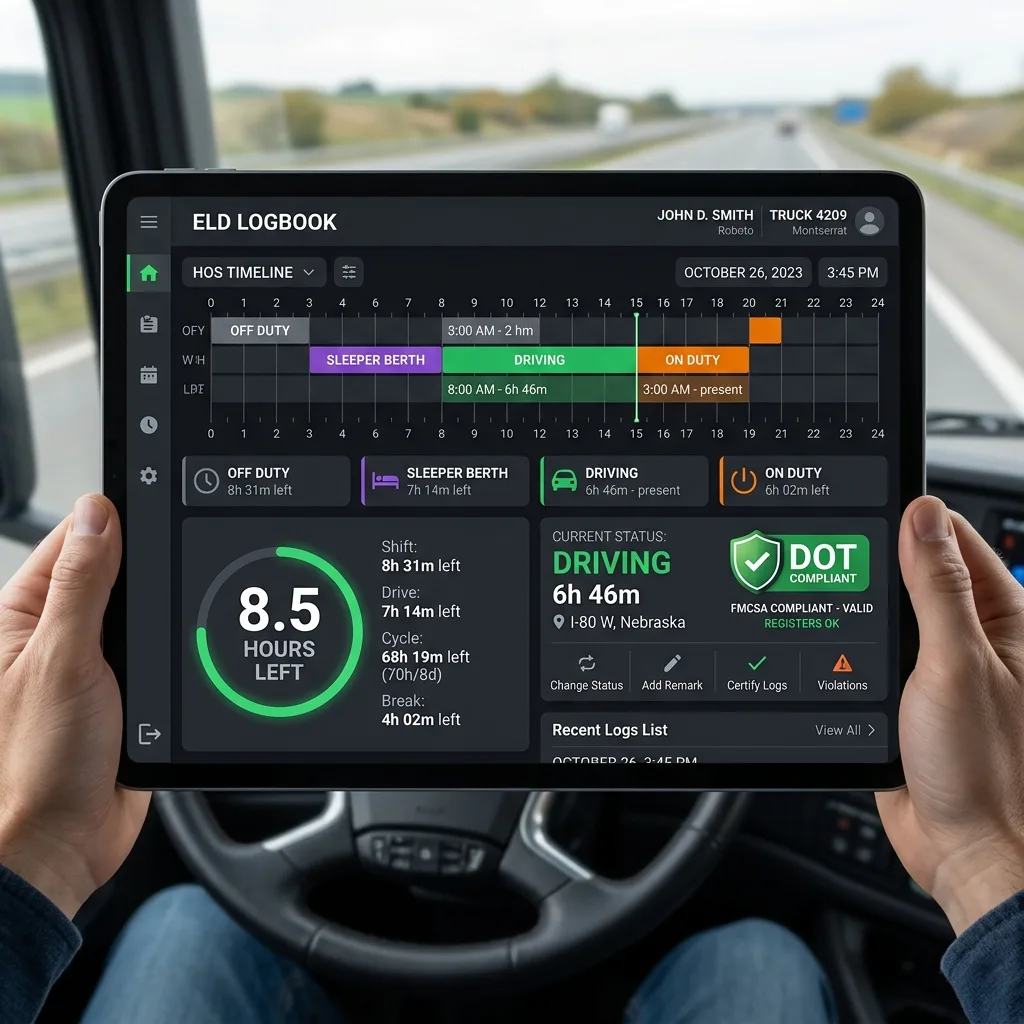
Our tablet app provides drivers with an intuitive visual timeline of their active shift states. In the event of a roadside DOT check, a single tap displays the secure compliance dashboard for instant officer review.
Our tablet app provides drivers with an intuitive visual timeline of their active shift states. In the event of a roadside DOT check, a single tap displays the secure compliance dashboard for instant officer review.
Instantly send logs directly to FMCSA servers during checks, or present a compliant DOT display screen to officers on the road.
Drivers can fill compliant vehicle check sheets (tires, lights, brakes) directly inside the mobile app before logging starting shifts.
Wireless Links Bluetooth logger plugs straight into heavy vehicle diagnostics ports. Broad-range support for J1939, J1708, and OBD-II interfaces.
Commercial motor vehicle drivers operating in the United States must strictly adhere to the Hours of Service (HOS) regulations established by the Federal Motor Carrier Safety Administration (FMCSA). These regulations are designed to prevent driver fatigue and ensure highway safety. Our certified ELD platform automated these complex rulesets to save fleets from costly compliance violations. The core HOS rules consist of three primary limits: the 11-Hour Driving Limit, the 14-Hour On-Duty Limit, and the mandatory 30-Minute Break rule. Additionally, drivers must adhere to cumulative limits, such as the 60-Hour/7-Day or 70-Hour/8-Day limits, which restrict driving time after a driver has spent a designated number of hours on duty over a consecutive multi-day period.
The 11-Hour Driving Limit: Under this rule, a driver is allowed to drive a maximum of 11 cumulative hours after returning from a period of 10 consecutive hours off duty. Once the 11-hour driving limit is reached, the driver must stop operating the commercial vehicle until they complete another 10-consecutive-hour rest break. If a driver continues driving beyond this limit, the ELD system automatically flags the logs as an active violation. This real-time flagging helps fleet dispatchers identify violations immediately, preventing trucks from traveling on public highways in an illegal and unsafe operational state.
The 14-Hour On-Duty Limit: This rule establishes a strict 14-hour window during which a driver can perform any work-related tasks, including driving, loading, unloading, vehicle inspections, or fueling. The 14-hour window begins running the moment a driver starts any on-duty work activity following 10 consecutive hours off duty. Crucially, the 14-hour clock is consecutive and cannot be paused by off-duty time, meal breaks, or personal tasks, unless the driver utilizes specific regulatory exceptions like the Split Sleeper Berth rule. Even if a driver only drives for 5 hours during their shift, they cannot drive anymore once the 14-hour limit has passed until they complete another 10 consecutive hours off duty.
The 30-Minute Rest Break Rule: Drivers must take a continuous 30-minute break after 8 cumulative hours of driving time without at least a 30-minute interruption. This break can be satisfied by registering as off-duty, sleeper berth, or on-duty non-driving. The integrated ELD timer tracks this interval and alerts the driver through an in-cab tablet notification when their driving limit approaches the 8-hour threshold, prompting them to find a safe location to park and log their mandatory rest break.
Cumulative Multi-Day Limits (60/70-Hour Rule): Depending on the company’s operating schedule, drivers must not drive after being on duty for 60 hours in any 7 consecutive days, or 70 hours in any 8 consecutive days. To reset this cumulative clock, a driver must take at least 34 consecutive hours off duty. This 34-hour restart is monitored by our cloud database and visible on the fleet dispatcher's console. Dispatchers can schedule routes effectively, knowing exactly when each driver's weekly cycle resets.
Connecting vehicles, drivers, assets, and cargo through intelligent telematics, GPS tracking, video safety, and IoT monitoring solutions.
Enter your work email for instant subscription rate plans.
Connecting vehicles, drivers, assets, and cargo through intelligent telematics, GPS tracking, video safety, and IoT monitoring solutions.
Enter your work email for instant subscription rate plans.
Flexible fleet solutions engineered for different cargo and asset environments.
Registro automático de las horas de conducción para cumplir con los mandatos de ELD.
Informes digitales de inspección del vehículo antes y después del viaje directamente desde la cabina.
Calcula automáticamente el kilometraje por estado para simplificar la declaración de impuestos sobre combustible.
High-quality tech architecture that guarantees reliable security and performance.
Combines high-sensitivity GPS receiver with cell-tower based triangulation (Cell-ID) to maintain signal.
Built with automotive-grade materials to operate in extreme weather conditions.
Modify reporting intervals and thresholds dynamically to optimize battery performance.
A highly optimized logic flow engineered to streamline operations and security reporting.
An official ELD User Manual describing how to operate the in-cab display.
An Instruction Sheet detailing the step-by-step process for data transfer during inspections.
An ELD Malfunction Reporting Guide outlining what to do if the hardware experiences issues.
A supply of blank paper log sheets (Form MCS-79) sufficient to record driver duty status for at least 8 days in case of device failure.
Technical specifications and radio bands details.
| Device Category | Wireless Telematics Gateway / Sensor |
| Radio Technology | Cat.M1 & NB-IoT / 4G LTE with 2G fallback support |
| Power Source | Lithium backup battery pack or standard 12V automotive tethering |
| Installation System | Industrial Neodymium magnets, double-sided bonding tape, or mechanical screw slots |
Estime los descuentos de hardware por volumen según el tamaño de su flota. Ajuste el control deslizante.
Common questions about deployments, configurations, and pricing plans.
It utilizes low-frequency cellular IoT network bands (NB-IoT/Cat.M1) to securely upload GPS coordinates, speed logs, and diagnostics. If there is a disconnect, it stores up to 5,000 logs locally and uploads them upon reconnection.
Settings such as geofence parameters, speed thresholds, and tracking report intervals can be updated dynamically over-the-air (OTA) via cellular SMS/GPRS commands without retrieving the device.